After nearly two years of renderings, debate and waiting, the Renaissance Center redevelopment is taking a major step forward.
The plan from Bedrock and General Motors, now estimated at $2.24 billion with the riverfront included, is entering Detroit’s community benefits process, giving residents a closer look at what could become one of the biggest changes to the city’s skyline and riverfront in decades.
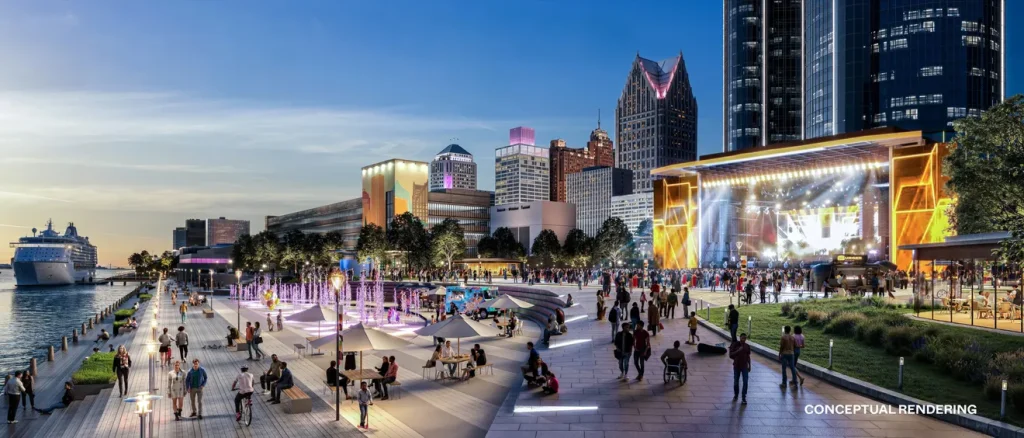
The plan includes demolishing two of the RenCen’s five original towers, removing the massive podium surrounding the complex, adding hundreds of apartments and opening up more of the Detroit Riverfront.
And this time, there is a timeline.
Demolition of Towers 300 and 400 is planned to begin in 2027. Before that happens, Detroiters are being asked what they want to see become part of the riverfront surrounding the complex.
Renaissance Center Timeline: When Each Phase Happens
The developers’ Transformational Brownfield Plan, posted by the Detroit Economic Growth Corporation ahead of a September 29 public hearing, lays out the schedule phase by phase. The hotel stays open through the middle of 2027 to serve what the plan calls a major national sporting championship, the NCAA Final Four at Ford Field that April. After that, the plan expects the complex to be completely vacant while work begins.
| Phase | What happens | Start | Finish |
|---|---|---|---|
| RenCen, Phase 1 | Towers 300 and 400 and the podium come down. The Center Tower becomes an 858-room hotel with about 200 apartments. New streets, parks and plazas go in. | 2027 | 2031 |
| RenCen, Phase 2 | Tower 100 converts from offices to 384 apartments. | 2033 | 2036 |
| RenCen, Phase 3 | Tower 200 offices are modernized as tenants sign. | 2034 | 2036 |
| Riverfront, Phase 1 | Marina, waterfront green, waterfront shops and restaurants, and the first entertainment anchor. | 2028 | 2031 |
| Riverfront, Phase 2 | Franklin-Atwater Park and the large entertainment anchors north of Atwater. | 2031 to 2033 | 2034 to 2036 |
| Riverfront, Phase 3 | About 350 apartments in two buildings, at least 20 percent affordable, plus one more entertainment anchor. | 2032 to 2036 | 2036 to 2038 |
The plan gives two sets of dates for the riverfront’s later phases. Its written description puts the apartments last, starting in 2036 and finishing by the end of 2038, which is the date WXYZ reported. Its own summary table lists 2032 to 2036. The RenCen dates match in both places, and the developer says the riverfront phasing may still change with community input and the market.
Tower 100 and Tower 200 are expected to start within 24 months of the first phase wrapping up. Work on Tower 200 will follow its tenants, so it could begin sooner if companies sign leases.
The Detroit Brownfield Redevelopment Authority holds its public hearing on the plan Tuesday, September 29, at 5 p.m. in the Committee of the Whole Room on the 13th floor of the Coleman A. Young Municipal Center, 2 Woodward Ave. Written comments can be emailed to the DEGC at ccapler@degc.org.
Renaissance Center Update: $548 Million in Public Subsidies Requested
Bedrock and General Motors are asking for $548 million in tax breaks and public money over 30 years to redevelop the Renaissance Center and build out the east riverfront, BridgeDetroit reports. The numbers came out Tuesday night, Sept. 15, at the project’s latest community benefits meeting.
The full price is now $2.2 billion. That total combines $1.6 billion for the RenCen itself and $600 million for the riverfront buildout. According to BridgeDetroit, the developers are putting in $1.7 billion in equity, about 74% of the cost, with $505 million in debt.
| Transformational Brownfield | $300 million in state taxes over 30 years |
| Renaissance Zone | $134 million in tax breaks over 30 years |
| PA 210 commercial property tax break | $39 million over 12 years |
| Downtown Development Authority | $75 million, already approved |
| Total | $548 million |
The plan counts 934 new homes across the RenCen and two new riverfront residential buildings, with 205 set aside as affordable. The expected return is about 1%, and Detroit Economic Growth Corp.’s David Howell told the meeting that “the answer was philanthropy.” Detroit City Council still has to approve the tax breaks.
The short version
- The RenCen buildings are scheduled to be finished by 2036, and the riverfront by 2036 to 2038, per the brownfield plan
- Demolition of Tower 300, Tower 400 and the podium is planned to begin in 2027
- The 73-story center tower would keep 858 hotel rooms while adding about 200 apartments
- A large new riverfront destination is planned east of the complex
- Detroiters can submit ideas for what they want to see along the riverfront
- Community benefits meetings run through October 27, 2026
- The Renaissance Center redevelopment is now a $2.2 billion plan, including the riverfront, with $548 million in public subsidies requested
Here is what is planned for the RenCen, what stays, what disappears and how Detroiters can have a say.
Which Renaissance Center towers are being demolished?
The biggest visual change would happen on the riverfront side of the complex.
Tower 300 and Tower 400, the two 39-story office towers closest to the Detroit River, are planned for demolition. The massive concrete podium surrounding the Renaissance Center would also be removed.
Demolition is currently expected to begin in 2027, following Detroit’s NCAA Final Four that spring.
The towers would not be imploded. Instead, crews are expected to dismantle them piece by piece, allowing for a more controlled demolition around one of downtown Detroit’s busiest areas.
Removing the podium could be just as significant as losing the towers.
For decades, the RenCen’s design has separated downtown from the riverfront. Bedrock and GM want to replace that setup with a pedestrian promenade connecting Jefferson Avenue directly to the Detroit River, along with new public spaces surrounding the remaining towers.
What happens to the rest of the Renaissance Center?
Three of the five original towers would remain, but the way they are used would change considerably.
The 73-story center tower would remain a hotel, with the current room count reduced to 858. Around 200 apartments would be added to the upper floors.
Tower 100 would be converted from office space into hundreds of apartments, while Tower 200 would remain office space and undergo renovations.
The broader Renaissance Center redevelopment also calls for new retail, dining, entertainment and recreation space throughout the property.
Instead of functioning primarily as an office complex, the goal is to turn the RenCen into a mixed-use district where people can live, work, stay and spend time along the riverfront.
GM has already left the Renaissance Center
One major part of the transition has already happened.
General Motors officially began moving employees into its new global headquarters at Hudson’s Detroit in January 2026.
GM had called the Renaissance Center home since 1996, making the move the end of a roughly 30-year run inside one of Detroit’s most recognizable buildings.
The automaker isn’t walking away from the RenCen completely, though. GM is working alongside Bedrock on its redevelopment and is contributing hundreds of millions of dollars toward the project.
A new Detroit riverfront destination is planned
The RenCen itself is only part of the plan.
Bedrock is also looking at roughly 30 acres surrounding the Renaissance Center and east riverfront, including areas currently dominated by surface parking.
The idea is to turn that land into a major public destination along the Detroit River.
And some of the ideas being considered go well beyond a traditional park.
Bedrock is asking residents for feedback on possibilities including a Ferris wheel, marina, floating swimming pool, movie theater, bowling, sports facilities and other year-round attractions.
The company has pointed to destinations such as Chicago’s Navy Pier and New York’s Chelsea Piers when discussing the type of active waterfront environment it wants to create.
Nothing on that list should be considered final. That’s part of the reason the public engagement process is happening now.
How can Detroiters give input on the RenCen plan?
Because the Renaissance Center redevelopment is seeking significant public incentives, the project falls under Detroit’s Community Benefits Ordinance.
That creates a formal process for residents to weigh in on the project, its potential impact and what community benefits should be attached to it.
The process includes public meetings and the creation of a nine-member Neighborhood Advisory Council made up of residents from the project’s impact area.
Community engagement began August 18 and is scheduled to continue through October 27, 2026.
Bedrock is also collecting feedback through an online riverfront survey, where residents can weigh in on the types of attractions, recreation and public spaces they would like to see included.
An engagement hub at 521 Atwater St. is also planned to give visitors a closer look at the redevelopment and riverfront concepts.
For anyone who has spent years saying the RenCen feels disconnected from the rest of downtown, this is the opportunity to put those opinions on the record.
Who is paying for the Renaissance Center redevelopment?
The full project, including the east riverfront, now totals $2.2 billion. Bedrock and GM are putting in $1.7 billion in equity and are asking for $548 million in public subsidies over 30 years, broken down in the table above.
Detroit’s Downtown Development Authority has also approved up to $75 million in reimbursements tied to portions of the project, including public improvements.
Another major piece involves Michigan’s Transformational Brownfield Program.
For more than a year, that funding was one of the biggest obstacles standing in the project’s way. Michigan lawmakers voted in July 2026 to double the statewide cap for the program from $1.6 billion to $3.2 billion.
That cleared a major financial hurdle for the RenCen redevelopment, although the project still has additional approvals to work through before everything is finalized.
The proposed riverfront improvements would involve additional investment beyond the core Renaissance Center redevelopment.
When will the Renaissance Center redevelopment start?
The first major construction activity is expected in 2027.
Detroit’s community benefits process runs through October 27, 2026. Demolition of Tower 300, Tower 400 and the podium is then planned to begin in 2027.
From there, redevelopment of the remaining towers and surrounding riverfront would happen in phases through the mid-2030s, on the schedule above.
That means Detroit won’t wake up to a completely different Renaissance Center overnight.
But after years of uncertainty surrounding the future of the complex, there is now a much clearer picture of what could replace it.
The RenCen has defined this stretch of Detroit’s skyline since the 1970s.
If the redevelopment moves forward as planned, the skyline will still have its tallest tower. What happens around it could look completely different.
Renaissance Center redevelopment FAQ
Is the whole Renaissance Center being torn down?
No. Tower 300 and Tower 400 are planned for demolition along with the podium at the base. The center tower, Tower 100 and Tower 200 would remain and be renovated or converted.
When does Renaissance Center demolition start?
Demolition of Tower 300, Tower 400 and the podium is currently planned to begin in 2027.
Will the Detroit RiverWalk stay open during demolition?
The current plan calls for dismantling the towers piece by piece rather than imploding them, helping limit disruption around the riverfront.
Is GM still headquartered in the Renaissance Center?
No. General Motors began moving employees into its new global headquarters at Hudson’s Detroit in January 2026.
What is happening to the main Renaissance Center tower?
The 73-story center tower would remain, with 858 hotel rooms and approximately 200 apartments planned for the upper floors.
How can Detroiters give input on the new riverfront?
Residents can participate in the community benefits process and submit feedback through Bedrock’s Detroit riverfront survey. Community benefits meetings are scheduled through October 27, 2026.
Follow RAW Detroit for more Detroit development updates.
Renderings via by Bedrock.